2026 Life Time UNBOUND Gravel 200: One of Our Biggest Races Yet!

BCC Live live-streamed the 2026 Life Time UNBOUND Gravel 200 from Emporia, Kansas — nearly eleven and a half hours of continuous coverage pulled off by a small in-studio team and a large field crew working motos, drones, aerial assets, and a heavy gear package through deep mud and sudden storms.

Behind the race itself was a months-planned logistics operation: rerouted motorcycle cameras, fuel- and FAA-bound flight windows, a finish-line camera kept live through a 3 a.m. thunderstorm, and a power plan built for redundancy. On course, Mads Würtz Schmidt soloed to the men’s win after a late mechanical and a selfless wheel hand-off from teammate Keegan Swenson, while Sofía Gómez Villafañe took the women’s race in a Specialized 1-2 with Geerike Schreurs.

Under a gray Kansas dawn on May 30, 2026, the BCC Live crew and more than 4,000 riders rolled out from Emporia for the 200-mile UNBOUND Gravel, the second round of the Life Time Grand Prix. Overnight rain had turned the Flint Hills’ gravel into a slick, clogging mess, but our team — four members in-studio and twelve-plus on the ground — settled in for what would become an 11-hour-and-30-minute day.

Within the first hour, thick mud bogged bikes and forced riders to dismount in the early technical sections. Both the men’s and women’s pro fields were immediately tested as crashes and mechanicals shattered the peloton. A lead group of roughly a dozen riders formed in the men’s race, while the women saw early attacks and a crash involving Karolina Migoń. The prairie quickly revealed its brutality: mud-caked frames, clogged drivetrains, and the first signs of the headwinds and intermittent storms that would define the day. The broadcasting conditions were equally challenging, as our Starlink and LiveU LU-800 Pro and LU900Q-connected motos and camera operators trudged through the rugged terrain, sharing every mile with the professional men’s and women’s fields.

BCC Live camera operator and Media Moto driver do the robot live on the 2026 Life Time UNBOUND 200 Gravel broadcast.

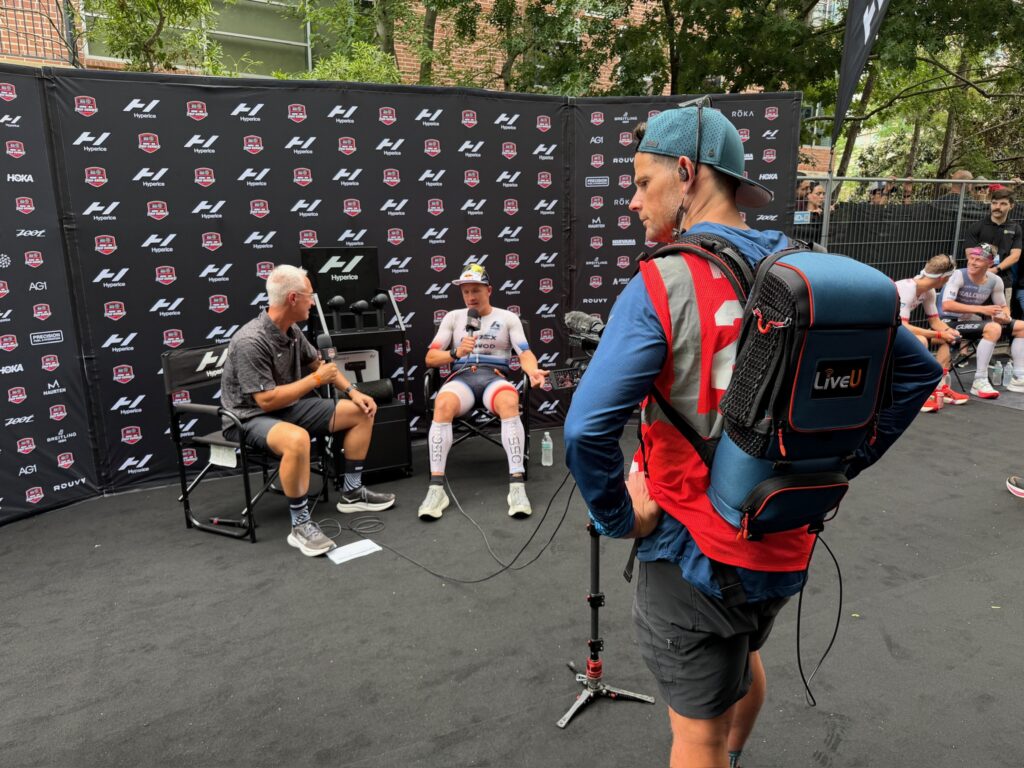
The on-the-ground production included scores of gear. The camera manifest for the day included 10 cameras consisting of Sony PXW-Z200s and Sony PXW-Z90s with mounted Sony ECM-VG1s, Sony ECM-XM1s and Rycote Softie Windshields as the race-action backbone of the production. We also used Sony FX6 cameras in studio with the commentators and race interviewees for cinema-quality shots. In the sky, Zak Heald from Intercut Productions and Stan Kartes from Summit Aviation VBT had our back, providing stunning aerial shots throughout the race.

The crew was also kitted out with 6 Starlinks, 4 DJI Ronins, 7 LiveU backpacks, and all the bells and whistles that make each piece of gear production-ready for the TriCaster in the Boulder, Colorado studio. Throughout the race, we also got the opportunity to test Yuzzit Smart Clip, saving our clipping team time and effort with AI-assisted and goal-directed show clipping, capturing all the right moments for the Life Time Grand Prix Youtube Channel, The Life Time UNBOUND Instagram profile, and Facebook page.

Despite great gear, technical know-how, and weeks of planning, UNBOUND Gravel is one of those events that humbles you. The course doesn’t care about your shot list, your run-of-show, or the weather window your team spent months negotiating around — two hundred miles of limestone gravel, unpredictable Kansas skies, and thousands of athletes spread across a corridor the size of a small state. It’s less a broadcast than a logistics operation that occasionally produces television.

The motos were the first reminder of that reality. Our motorcycle camera operators are our eyes deep in the course, and when the roads turn to soup after a rain, those bikes go down or get stuck the same as anyone else’s. We lost position coverage in the latter half of the race as motos were diverted around flooded tunnels and deep mud, forcing us to reroute communication plans on the fly and lean on our aerial assets harder than we’d budgeted for.

That budget — fuel burn, flight time, FAA log requirements — had already been mapped down to the minute. Helicopter coverage at an event like this isn’t “point the camera and fly.” Every flight plan accounts for fuel stops, mandatory crew-rest windows, and log times the pilots have to hit precisely. When we extend a flight window because a moto is stuck in a ditch somewhere in the hills, we’re making real-time decisions that cascade down the entire operational chain.

The age-group athletes finishing in the overnight hours are part of Unbound’s soul, and we take that coverage seriously. This year that meant a finish-line camera stationed at the chute past 3 a.m. — through a thunderstorm that rolled in with almost no warning. Keeping a camera live in those conditions takes more than waterproof housings. It takes a crew genuinely committed to standing in the dark and the rain, because someone’s family is on the livestream waiting to watch them cross. That shot matters as much as anything we put on air during the pro finish.

Power was its own operation within the operation. Remote broadcast work at an event this geographically dispersed means building a battery plan the way an endurance athlete builds a nutrition plan — carefully, with contingencies, and with a clear understanding that something will deviate. We mapped power needs for every camera position, every transmission point, and every support vehicle, built in redundancy where failure would cost us coverage we couldn’t recover, and ran daily checks to stay ahead of anything that wanted to quietly die overnight. For nearly 24 hours of continuous coverage, there is no moment where you can afford to say “we’ll figure it out.” The figuring-out happens in the weeks before the trucks ever leave the yard.

Equipment failures happen. This year we were fortunate — the list was short and none of it was catastrophic. That isn’t luck as much as it is preparation: a months-long process of redundancy planning, equipment checks, and honest conversations about where the single points of failure live in your system.

In the men’s race, the decisive move came around mile 60 on the steep pitches of Texaco Hill. Mads Würtz Schmidt and Keegan Swenson of Specialized Off-Road, joined briefly by Cobe Freeburn, attacked and quickly opened a gap that grew to several minutes. Freeburn eventually faded, leaving the two Specialized teammates to trade pulls and extend their advantage to over seven minutes. Then, around mile 120–150, disaster struck…

Mads Würtz Schmidt suffered a sidewall cut that multiple plugs could not seal. Swenson immediately sacrificed his own race, handing over his wheel so his teammate could continue solo. Swenson then battled his own freehub issues before fighting back heroically to finish fifth. Behind them, Matthew Beers chased aggressively while Tobias Kongstad held third in the reduced chase group. Würtz Schmidt soloed the final 50+ miles through punishing headwinds, crossing the line first in 9:14:51.

The women’s race followed a different but equally dramatic script. After early mud chaos and mechanicals, a powerful quintet emerged: Sofía Gómez Villafañe and Geerike Schreurs of Specialized, Cecily Decker of PAS Racing, Rosa Klöser, and Paige Onweller, who bridged multiple times despite bike troubles. The group stayed together through more mud, crashes (including Schreurs going down twice), and brutal headwinds on exposed sections like the Kahola Lake climb. Team tactics were clear: if it came to a sprint, Specialized would lead out for Gómez Villafañe. With roughly seven miles remaining, the group crested Highland Hill and descended toward Emporia. On the final drag down Commercial Street, the Specialized duo executed perfectly.

Gómez Villafañe took the sprint victory in 10:31:37, with Schreurs second just one second back and Decker third—securing a Specialized 1-2 in the women’s race for the second straight Grand Prix round. Würtz Schmidt’s gritty solo win and Beers’ strong chase gave the team three of the top five men’s spots as well. Riders finished mud-splattered and exhausted after nearly 10 hours (women) or just over 9 hours (men) of racing in conditions that turned the “Super Bowl of gravel” into a true test of resilience. The day ended with celebrations in Emporia, Würtz Schmidt praising Swenson’s selfless wheel sacrifice and Gómez Villafañe calling the one-two result “unreal,” as the 2026 Life Time Grand Prix continued its high-stakes narrative for all of the other 4,000 riders involved.

What you see on the broadcast is the race. What you don’t see is the infrastructure — the early-morning troubleshooting calls, the rerouted motos, the camera operator standing in the rain at 3 a.m. — that makes it possible to put the race in front of you. The riders crossed the line spent and mud-caked; our crew packed out knowing the day had asked everything of the plan, and the plan had held.